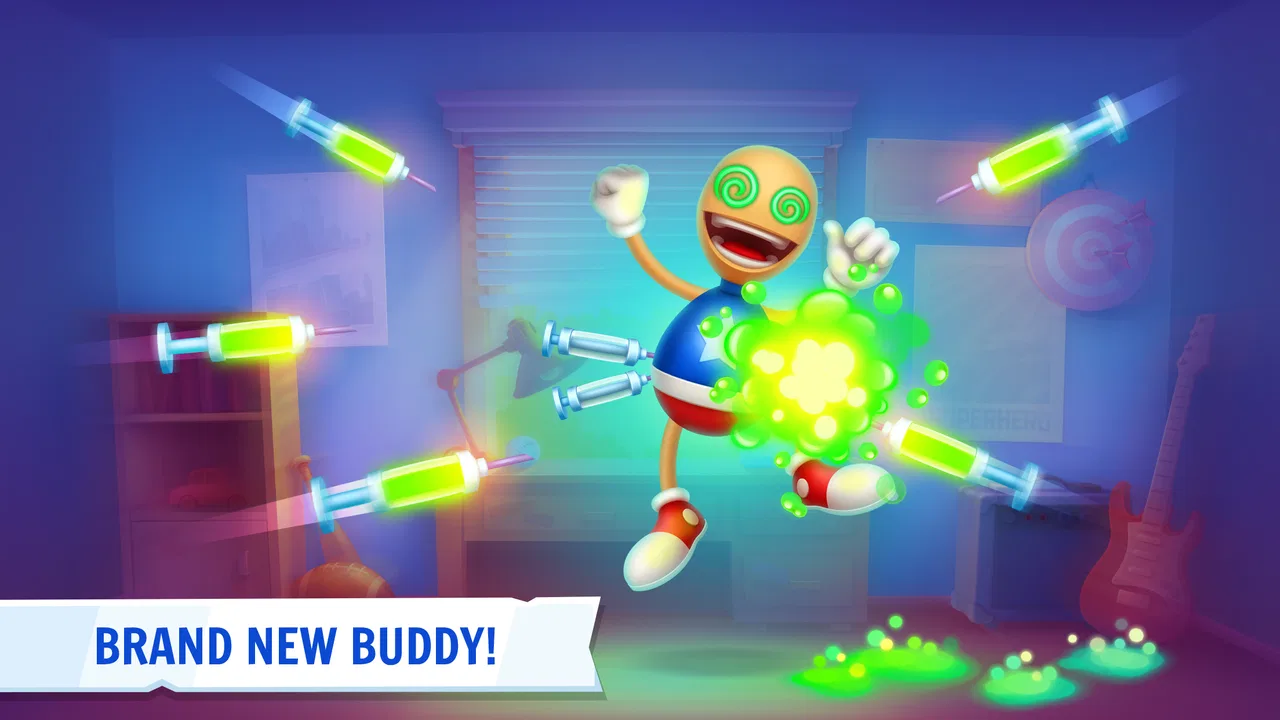
Kick the Buddy: Forever
- 4.5
- Rating
- 50.00M
- Installs
- Free
- Price

 Analysis by App-foxy
I downloaded Kick the Buddy: Forever expecting a quick action game built around simple physical comedy, and that is exactly where it makes its strongest impression. You interact with a ragdoll character, try different actions, watch the immediate reaction, collect the result of that interaction, and then start again with a slightly different idea. The appeal is not a long story or a complicated mission structure. It is the satisfying little cycle of doing something, seeing what happens, and deciding what to try next.
That simplicity makes it easy to pick up when I have only a few minutes. It also explains why the game can become repetitive if I approach it as a conventional action title. There is no need to master a large map or remember a complicated control scheme. Instead, the game asks whether its collection of reactions, tools, and playful destruction can keep my curiosity alive. For me, the answer is yes in short sessions, although the experience depends heavily on how much I enjoy experimenting with the same central idea.
How the first action sets up the whole experience
The first thing I noticed is how quickly the game communicates its purpose. I do not need a long tutorial to understand the basic interaction: the ragdoll is there to be hit, moved, launched, or otherwise subjected to whatever action I choose. That directness is useful on a phone because I can begin playing almost immediately rather than spending the opening minutes learning a complicated interface.
You May Also Like

 Blood Strike: 2.5 Anniversary
Blood Strike’s Loadouts Turn Every Drop Into a Tactical Gamble
A close look at Blood Strike’s custom loadouts: how fast access to signature weapons reshapes its battle royale rhythm, rewards preparation, and narrows the gap between fights.

 Pandora - Music & Podcasts
Pandora’s Music Is Easy to Start, but Harder to Recover
Pandora’s strength is its low-effort path from a seed to a station. Its weak spot is how much confidence it asks you to place in connection, setup, and quiet recovery.

 8 Ball Pool
 Is Built on Rivalries, Rematches, and Routine
A close look at the rivalries, rematches, shared routines, and unanswered safety questions that turn a quick pool match into a persistent mobile community.

 Samsung Music
’s Quiet Strength Is Playing What You Already Own
Its reach comes less from spectacle than from dependable access to a personal library. That simplicity is both the app’s strongest retention engine and its ceiling.

 AccuWeather: Weather Radar
AccuWeather Review: A Quick, Clear Forecast for Everyday Decisions
For everyday plans, the best forecast is the one you can understand quickly. AccuWeather makes rain timing, radar, and local conditions easy to act on, with a few trade-offs.

 Hill Climb Racing
Why Hill Climb Racing Still Turns Crashes Into One More Run
A tiny car, a bumpy hill and one more upgrade: Hill Climb Racing keeps resurfacing because its simple chaos makes every near-miss feel personal.
More From Our News Desk



The controls are designed around touch interaction, so the experience feels more like handling a toy than steering a traditional action hero. I tap and drag, choose an option, and watch the character respond. The important part is that the game gives me feedback right away. Even a small action has a visible consequence, which encourages me to try another one instead of waiting for a mission prompt.
This is also where the game’s tone becomes clear. It is cartoonish and deliberately exaggerated, but the content rating is Teen, so I would not treat it as a children’s game simply because the presentation is playful. Parents should check whether this type of slapstick violence fits their household before handing it to a younger player.
Playgendary Limited keeps the premise focused rather than dressing it up as a large adventure. That focus is a strength when I want an uncomplicated distraction. If I am looking for a story-driven action game, character development, or a campaign with meaningful objectives, this is not the right place to start. The game is about the interaction itself, not about reaching a dramatic ending.
The useful difference between tapping and experimenting
A generic approach is to repeat the most obvious action until the novelty fades. I found the experience lasts longer when I treat each attempt as a small experiment. Instead of immediately selecting the strongest-looking option, I pay attention to how the ragdoll moves, where the impact lands, and how the scene changes after the action. That turns a basic tap into a short test: what happens if I change the timing, position, or choice?
This matters because the game’s entertainment comes from feedback rather than from a traditional win screen. The reward is often the reaction itself. A player who enjoys observing cause and effect will get more from the same tools than someone who wants constant new levels.
I also recommend trying the game with sound at a comfortable level rather than muting it automatically. The visual response is the main attraction, but the impact cues help make each action feel finished. At the same time, sound is not enough to rescue a repetitive session, so I would not keep playing purely because the effects are amusing.
Why the feedback rhythm works in short bursts
The core rhythm is easy to describe: action, reaction, reward, reset, and another action. I choose something to do, the ragdoll responds, the game gives me a reason to continue, and I return to the playground with a new idea. That rhythm is compact enough for a waiting room, a commute, or a short break between tasks.
One realistic use case is a ten-minute pause during a busy day. I can open the game, try a few different interactions, and close it without feeling that I have abandoned a long mission. There is no pressure to remember a complicated plot when I return later. The downside is that the same convenience can make the game feel disposable if I am playing for an hour without changing my approach.
My best sessions happen when I give myself a small goal, such as exploring a new option or seeing whether a different sequence produces a more entertaining response. That self-made goal is important. Without it, the game can become a string of taps where I am watching but not really playing.
The visual feedback is also useful for learning what the game considers satisfying. Some actions feel more rewarding because the reaction is more dramatic or because the result is easier to notice. I do not need to calculate anything, but I do start recognizing which choices create a better moment. That informal learning gives the loop a little more depth than the store summary suggests.
Rewards, spending, and the reason to begin another session
The reward structure is what decides whether the first few minutes become a habit. In my experience, the reward is less about completing a conventional objective and more about unlocking the possibility of another interaction. I perform an action, enjoy the response, and then want to see whether a new selection can produce a different kind of result.
That makes the game approachable, but it also creates a clear trade-off. Players who need visible progression, carefully balanced challenges, or a strong sense of achievement may find the rewards light. Players who enjoy collecting options and testing them against the ragdoll will understand the appeal more quickly.
The game is free to download, with in-app purchases ranging from $0.99 to $89.99 per item. I would keep that in mind before treating the game as a completely cost-free experience. The basic entry point is easy, but the presence of purchases means I would review any spending settings before letting someone else use the device, especially a younger player.
My advice is to play the free portion long enough to decide whether the interaction itself is enjoyable. Do not assume that buying more content will solve repetition. If the action-and-reaction loop already feels entertaining, additional options may extend that curiosity. If the central joke has stopped working, spending more is unlikely to change your opinion.
How I decide whether another round is worthwhile
I use a simple test: after an action, do I have a specific next experiment in mind? If the answer is yes, the loop is still working. Maybe I want to compare two choices, try a different order, or see whether a new item changes the response. If my only reason to continue is that I have already started, I close the game and return later.
This approach prevents the reward cycle from turning into mindless repetition. It also highlights one of the game’s less obvious strengths: it respects very short sessions. I can stop after a few interactions without losing the thread, then reopen it when I feel like experimenting again.
There is no need for a long uninterrupted play period to understand the appeal. In fact, I think the game is better when played in small portions. The reset between sessions gives the reactions time to feel fresh again. Extended play makes the similarities between attempts more noticeable, while brief visits preserve the sense of a quick toy box.
The reset is part of the design, not a failure
Many action games use a reset to punish mistakes or send the player back to a checkpoint. Here, resetting feels different. I am not usually recovering from a failed mission; I am returning to the playground so I can choose another action. That makes the reset feel closer to putting down one toy and picking up another.
This structure is friendly to casual players because there is little commitment. I can experiment without worrying that a poor choice will ruin a long run. The same freedom can feel shallow to players who want risk and consequence. If every session is mainly a fresh setup for another reaction, there is less tension than in an action game where survival or progression matters.
I found the reset most useful when I deliberately changed my objective. One session might be about discovering which interactions look most dramatic; another might be about testing the environment or simply enjoying the funniest sequence I can create. That change in mindset keeps the reset from feeling like a return to the exact same starting point.
It is also why I would not compare this game directly with a level-based brawler. A brawler usually asks me to improve my timing, defeat opponents, and advance through increasingly difficult encounters. Kick the Buddy: Forever asks me to explore a playful system and decide when the current experiment has run its course. The two genres may share action controls, but they provide different kinds of satisfaction.
Where it fits among action games
Compared with a fighting game, this title has less emphasis on competition and technical mastery. There is no opponent strategy for me to study in the usual sense, and the ragdoll is more of a responsive object than a rival. Compared with a physics puzzle, it is less about finding one correct solution and more about enjoying the response to a chosen action.
That places it closer to a digital playground than to a traditional campaign. I would recommend it over a competitive action game when I want something private, low-pressure, and easy to pause. I would choose a conventional brawler instead when I want demanding controls, clear victories, and a stronger feeling that my skill is improving.
The game is available for Android users on version 7.0 or later, and the current version is 2.0.22. Those details make it accessible to many existing devices, but I would still consider the phone’s age and available storage before installing any game. More importantly, the experience is best judged by the screen interaction itself: if you dislike repeated tapping, dragging, and watching the same character react, compatibility will not make it enjoyable.
The audience numbers suggest that the format has broad appeal: it has passed 50 million installs, with a 4.5 average from roughly 775 thousand ratings and about 54 thousand written reviews. I see those figures as evidence that the simple premise connects with many players, not as a guarantee that it will suit everyone. A large audience cannot remove the central limitation, which is that the game’s variety is built around one main activity.
Small habits that improve the experience
I get better value from the game when I avoid treating every available option as something to use immediately. I choose one action, watch the complete response, and only then move on. This makes the feedback easier to notice and stops the session from becoming a blur of rapid taps.
Another useful habit is to take breaks before the reactions become predictable. The game’s reset is most effective when I use it as a natural stopping point. Closing the app after a satisfying experiment leaves me with a reason to return, while forcing a long session can turn the same playful mechanics into background noise.
I would also keep purchases separate from experimentation. First I decide whether I enjoy the free loop; then I consider whether an additional option would genuinely give me a new reason to play. This is a better test than buying simply because the game has made me curious for a few minutes.
Finally, I would not use it as a substitute for a calm puzzle game. The exaggerated action can be amusing, but it is still built around cartoon violence and impact. Someone who wants quiet concentration, a story, or a relaxing visual experience may be happier with a different category altogether.
Who should install it and who should skip it
I think the game is a good fit for players who enjoy physics-based reactions, playful experimentation, and short sessions with no complicated commitment. It works especially well for someone who likes opening a game during a spare moment, trying a few interactions, and leaving before the novelty wears thin.
I would recommend skipping it if you need a campaign, multiplayer competition, deep character progression, or a demanding skill curve. The game does not replace those experiences. It offers a narrow idea and explores that idea through repeated feedback, which is either its charm or its biggest weakness depending on what you want from an action game.
The Teen rating is another reason to choose carefully. The presentation may look humorous, but the repeated focus on hitting and torturing a ragdoll is not suitable for every player or family. I would make that decision based on the tone of the person playing, not just on the cartoon style.
After spending time with it, I see Kick the Buddy: Forever as a compact action playground whose success depends on the quality of its loop rather than on narrative ambition. The first action is immediate, the feedback is clear, the reward is the invitation to try something else, and the reset makes another experiment effortless.
That loop is enjoyable when I approach it with curiosity and restraint. I can create a small personal challenge, observe the result, and stop at the right moment. It becomes less convincing when I expect a full action adventure or keep repeating the same interaction after the surprise has gone.
My final recommendation is therefore positive but specific: try it if you want a free, touch-friendly distraction built around cartoon ragdoll reactions, and judge it during short sessions before considering any purchase. For me, the reason to begin another session is not a promised grand reward; it is the possibility that one more action will produce a better, stranger, or simply funnier response. That is a modest idea, but the game understands it clearly.
FAQs for Kick the Buddy: Forever
01What is the main objective of Kick the Buddy: Forever?
Kick the Buddy: Forever is a casual stress-relief game where players interact with a virtual buddy using a variety of weapons and tools. The main objective is to creatively use the available items to unleash stress and earn in-game currency. This currency can be used to unlock more weapons and customization options.
02Is Kick the Buddy: Forever suitable for children?
The game is rated for ages 12 and up due to its cartoonish violence. While the graphics are not realistic, the concept involves inflicting harm on a character. Parents should consider whether the game's content aligns with their values before allowing their children to play.
03Are there in-app purchases in Kick the Buddy: Forever?
Yes, Kick the Buddy: Forever offers in-app purchases. Players can buy in-game currency to unlock new weapons, tools, and outfits more quickly. While it's possible to progress without spending money, some users may find the game more enjoyable with these purchases.
04Can Kick the Buddy: Forever be played offline?
Kick the Buddy: Forever requires an internet connection for some features, such as ads and in-app purchases. However, the core gameplay can be enjoyed offline. Playing offline may limit access to certain rewards and features that rely on internet connectivity.
05How does the game handle ads?
Kick the Buddy: Forever includes ads that can appear between gameplay sessions. Players have the option to watch ads voluntarily to receive bonuses or skip waiting times. To remove ads, users can make an in-app purchase, which enhances the gaming experience by providing uninterrupted play.
Pros
- Highly entertaining stress reliever
- Vibrant and colorful graphics
- Wide range of weapon options
- Simple and intuitive controls
- Frequent updates with new content
Cons
- Can be repetitive over time
- In-app purchases can get pricey
- Ads can interrupt gameplay
- Requires internet for some features
- Limited strategic depth

Kick the Buddy: Forever
Gallery